Tuesday, July 29, 2014

Is Mexico City Disappearing???

Don't adjust your computer: this building is just one of many
that is tilting in Mexico City due the sinking aquifer under the
city. Photo from: (http://mishmaus.com/usran-posao/)
     Mexico City is the world's third largest city with over 18 million people and it is sinking at an average of 2.5 inches a year.
     Why is it sinking? The almost 20 million people living there are sucking up the water from the aquifer beneath the land so quickly that as the aquifer drops, so does the ground above it.
     About 70% of the water supply comes from the aquifer below the city. The water is being used so quickly that it cannot be replaced, which is continuing to weaken the foundation and the aquifer has become nothing more than a dried, muddy, lake bed.
     The city was built on the middle of Lake Texcoco on a series of islands. As the city grew, engineers made artificial expansions along with a large network of canals which roads were built on. The lake was eventually dried out and the city continued expanding using the lake bed as the foundation.
     Tim Johnson from the Seattle Times claims, "Walk into any of hundreds of homes or buildings in the huge capital, Mexico City, and you feel immediately that something is amiss. The buildings tilt." (1)
     "The notion that Mexico City is sinking is not new, but the extent to which it is sinking is causing alarm among experts. Experts from the National Autonomous University of Mexico (UNAM) say, 'the city fissures are generating alarm among the population and even cause significant damage to buildings and (affecting provision of) public services." (2)
     "According to engineers, to prevent the city from sinking further it must stop pumping water from the aquifers or replenish the supply. This will help stabilize the foundation, but it will not raise it."
(2)
     The sinking city is causing a lot more than just leaning buildings too. Enrique Santo Villa, an engineer who is experienced at propping up and bolstering churches, monuments, and other tilting structures said, "When a building tilts more than 1 degree, then I think it begins to become very uncomfortable." (1)
     If a building is 100 feet high and the building is tilted at 1 foot, it is noticable by those who live in it. "'One notices it while laying in bed...washing the dishes and seeing the tap water flow oddly...tables aren't stable. Liquids don't look right when they are in big containers...Window panes can break. Doors don't close right,' Santoyo said." (1)
     There are also buckling sidewalks, expensive subway line and road repairs, gas lines and electrical lines are also at risk or rupturing and causing major health concerns. Some people even feel vertigo due to the tilt in the city.
     How would you stop the city from sinking more, yet provide water for the city? Post your ideas and comments here!


      Works Cited
     (1) Johnson, Tim "Mexico City copes with that sinking feeling." The Seattle Times. Web.        
         24 September 2011, Seattle, WA.
 (http://seattletimes.com/html/nationworld/2016310507_mexicosinking25.html)
     (2) Unknown Author "Mexico City's sinking is worsening." Homeland Security News Wire. Web.
        21 January 2011
(http://www.homelandsecuritynewswire.com/mexico-citys-sinking-worsening)

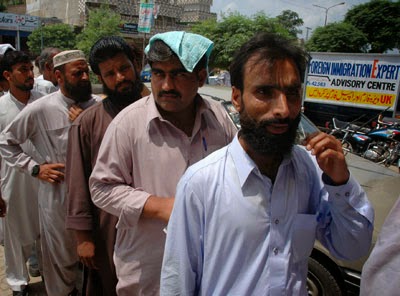
Why is Pakistan's Net Migration Rate So Low?

Pakistanis move to Britain for a better life. The net migration
rate for Pakistan in 2012 was -2/1000 in the population.
(Photo from: "The Economist.")

      In Globalization and Diversity: Geography of a Changing World, explains low migration rates as "more people are leaving than arriving." (p. 16)
      In 2012, the net migration rate in Pakistan had a net loss of 2 people per every 1,000 in the population.
      There are many many reasons for Pakistan's low net migration rate.
      They are 174th in per capita GDP making them a very poor population, and do not have much of a middle class.
      Many are farmers and the lands can't hold a growing population.
      Another reason Pakistan has a low net migration is because they invest little in education and economic infrastructure and very high in corruption.
      "The majority of respondents consistantly view the police as being the most corrupt sector of Pakistani government. In the 2010 survey, 31% of 4,224 respondents reported paying bribes to the police.'" (2)
       "Bribery is also involved in billing for electrical power and regarding taxes. Wikipedia:'According to the 2002 study, 99% of 256 respondents repondents reported paying bribes to have their tax assessment lowered, and nearly 14% reported receiving fictitious tax assessments until a bribe was paid.'" (2)
        If Pakistanis insult the Koran or the Prophet Mohammed, they could be put to death which is hard for the 5% of Christians and Hindu's in the region.
       "Each year 250,000 Pakistanis come to Britain to visit, work or marry, and some 350,000 British citizens journey in the opposite direction, mainly to visit family. Links are reinforced by ingrained marriage customs: six of ten ethnic Pakistanis in Britain pick a spouse from Pakistan." (3)
       "Those busy borders [Britain and Pakistan] have been a boon in various ways. British universities rake in around £10,000 ($15,000) per person from their share of the 10,000 or so Pakistanis admitted each year on student visas, and businesses sponsor a couple of thousand Pakistani workers a year to plug gaps in the labour market. But the easy comings and goings between Britain and “the most dangerous place in the world”...Pakistan's western regions..." (3)
       I believe that Pakistanis are moving out of Pakistan because of corruption, war, persecution, more economic stability, and religious freedom...now's your chance...What do you think??? Leave your thoughts in the comments below.

      Works Cited
     (1) Rowntree, et al. Globalization and Diversity: Geography of a Changing World. New Jersey: Pearson             Prentice Hall, 2011
     (2) Smitha, Frank A. "Islamic Republic of Pakistan." Macro History and World Report. Web.
          (c) 2009-2013 (http://www.fsmitha.com/world/pakistan.htm)
     (3) Bradford "Pakistan and Britain: The Immigration Superhighway." The Economist. Web. 
          16 April 2009  (http://www.economist.com/node/13497357)